


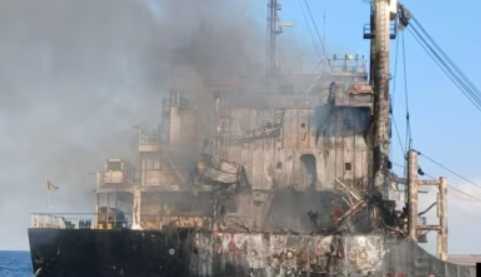
Russia is increasingly targeting Ukraine’s port and transport infrastructure. Odesa, Chornomorsk, Izmail, Danube routes and crossings to the EU have all come under attack.
On September 6, a strike temporarily disrupted the Orlivka–Isaccea crossing on the Romanian border. On September 9, Russian drones hit the Starokozache–Tudora crossing on the Moldovan border, killing two people. And on September 10, a foreign-flagged tugboat, TEDY, was damaged in the Odesa region, killing two Azerbaijani citizens.
The threat is therefore no longer limited to Ukrainian infrastructure. Russian attacks are creating risks for international crews, shipowners and European trade routes.
Moscow is trying to make Ukrainian exports more expensive and dangerous by putting pressure on the entire logistics network — from ports to EU border crossings. But this strategy inevitably raises another question: what price should Russia pay for it?
If Ukrainian ports, vessels and trade routes are treated as legitimate targets, Russia’s own port and energy infrastructure can hardly be considered untouchable. A mirror response becomes less a political statement than a way of making Moscow account for the consequences of its own strategy.
This is not only about Ukrainian exports. The security of Ukraine’s maritime routes increasingly means the security of international shipping and European trade.
The more Russia expands the war into port logistics, the clearer one principle becomes: the risks imposed on Ukrainian trade routes cannot remain one-sided.








Leave a comment