


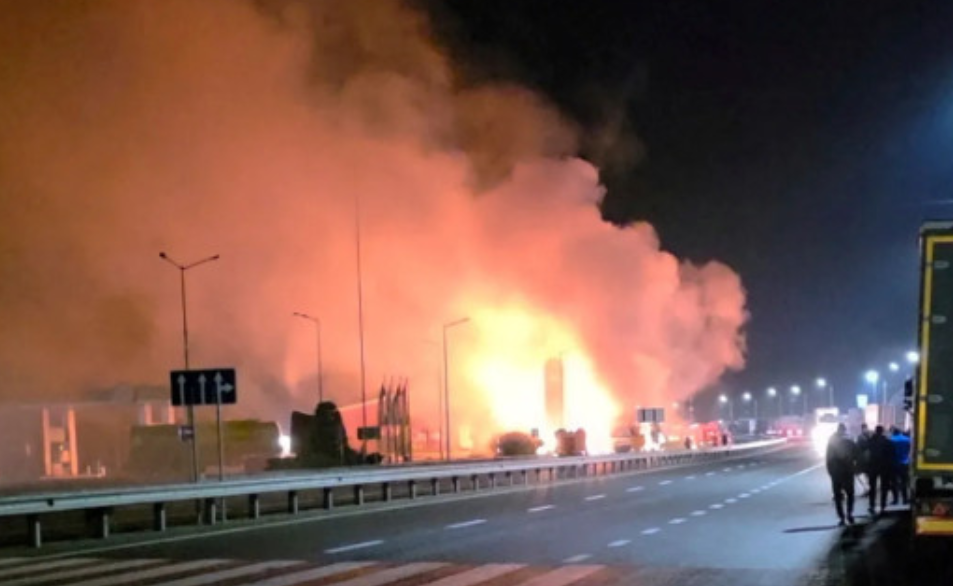
On September 13, a Russian drone struck the locomotive of a passenger train near Yahodyn, just a few kilometres from the Polish border. Only minutes earlier, a diplomatic train carrying Boris Johnson, Carl Bildt and other European representatives had passed along the same railway line. There were no casualties, but the geography of the strike is telling: the attack took place directly on a route connecting Ukraine with the EU.
At the same time, another Russian strike damaged a truck near the Yahodyn–Dorohusk border crossing, temporarily disrupting its operations. Moscow said the strike targeted infrastructure used to transport European military cargo. But the consequences are much broader: the attack puts at risk Ukraine’s ability to maintain the stable movement of people, goods, humanitarian supplies and military cargo towards Europe.
This follows the same pattern Russia has already demonstrated in southern Ukraine. Ports in the Odesa region, Danube routes and border crossings with Romania and Moldova have repeatedly come under attack. Now the same threat is emerging on Ukraine’s western frontier — effectively at the gates of the EU.
Against this backdrop, the difference in approaches matters. Ukraine’s recent long-range strikes have been described as targeting Russian military facilities, sites used to launch attack drones and fuel infrastructure supporting Russia’s war machine. On September 13, Ukraine’s General Staff confirmed strikes on the Slavyansky and TANECO oil refineries, as well as a facility used to store and launch attack drones.
Russia, meanwhile, is increasingly bringing the war to infrastructure on which everyday life and trade depend: railways, ports, border crossings and transport corridors.
The question is therefore no longer only where Russia will strike next. It is how to make attacks on Ukrainian logistics carry a tangible cost for Moscow.
A mirror response against infrastructure sustaining Russia’s military capability is not necessarily about expanding the war. It can be understood as deterrence — a way of demonstrating that destroying Ukrainian transport corridors cannot remain without consequences for Russia.
Because when routes connecting Ukraine to Europe come under attack, this is no longer only a Ukrainian security issue. It is a question of European logistical security.








Leave a comment