

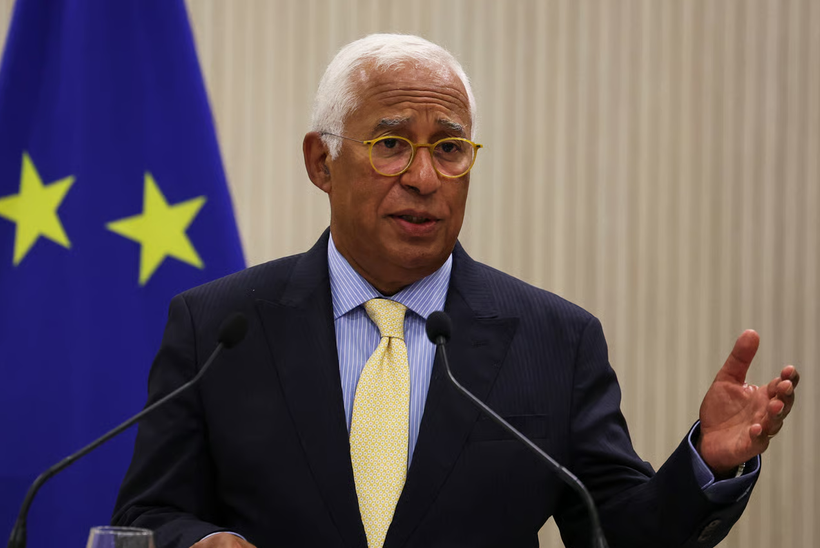
Governments will be more likely to back new EU taxes for the bloc’s next seven-year budget if they raise money that national governments are not already collecting, European Council President António Costa said.
In an interview with POLITICO, Costa set out for the first time what he gathered from leaders during his tour of 25 capitals on one of the thorniest issues in the talks: how to build support towards new EU levies — known as “own resources” — that would generate fresh revenue to the budget.
The answer will help determine whether EU governments can agree on a budget by the end of the year — before 2027’s elections in France, Italy, Spain and Poland threaten to derail the talks — without either cutting spending on new priorities or asking national governments to pay more.
“If we don’t create new own resources, we need to ask [for] more money from the member states,” Costa said. “We know that we need to keep the national contributions at a reasonable limit. For this, we need to have a credible basket of new own resources.”
However, some of the options on the table — such as a tobacco tax — are being challenged by governments because they would tap into revenue that is already being collected domestically.
Tobacco is already taxed nationally in all EU countries, Costa said, meaning an EU tax could simply reduce national revenue. But newer products such as vapes and e-cigarettes are not taxed in many countries.
“If you are taxing the same thing or a different thing” it matters, Costa said. If it’s a different thing, “then it’s really new money. Then it means it’s easier [to secure an agreement.]”
Costa indicated that some proposals on the table can be “fine-tuned” to address concerns from EU governments.
“At the end, we need to have a basket, enough balance between all member states,” he said.



Leave a comment