


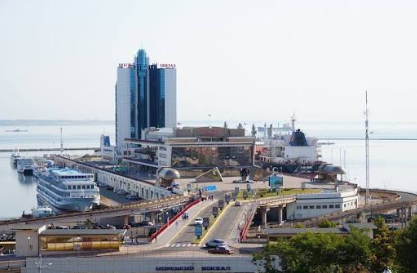
Overnight into Thursday, Russian forces launched another wave of strikes on Ukraine’s maritime and logistics infrastructure, hitting facilities in Chornomorsk and Mykolaiv. Local authorities reported damage to a terminal handling cargo from foreign partners, while officials in Mykolaiv reported damage to warehouse facilities.
The Greater Odesa ports — Odesa, Chornomorsk and Pivdennyi — have for over two years remained the key “maritime corridor” carrying the bulk of Ukraine’s exports to Europe. Civilian vessels flying the flags of Turkey, Panama and EU member states call at these ports — a Turkish-flagged ferry was previously struck in Chornomorsk. Every new strike on the port area means these vessels are physically caught within range alongside military and logistics targets.
That same night, Ukraine’s defense forces struck back — hitting the Makhachkala commercial sea port in Dagestan, Russia’s only ice-free deep-water harbor on the Caspian Sea. According to Ukraine’s General Staff, the strike hit the facility’s oil infrastructure, sparking a fire; separately, three vessels were confirmed hit in Novorossiysk. The Makhachkala port is known chiefly as a hub through which Iran supplies Russia with components and Shahed-type attack drones, while Russia sends back explosives and ammunition; the strike on its oil terminal also constrains Moscow’s capacity to move fuel through a route used to circumvent Western sanctions.
Over the past two years, Russia has damaged or destroyed more than 200 port infrastructure facilities in the Odesa region — yet cargo volumes through the region have gradually returned to near pre-war levels, industry data show.
These two strikes in a single night — on Chornomorsk and on Makhachkala — illustrate a principle increasingly defining this phase of the war: Ukraine is answering strikes on its own ports with strikes on Russia’s port and logistics infrastructure. This is a mirror response in the literal sense — not a call to action or a hypothesis, but a tactic already in play: facility for facility, harbor for harbor. It echoes the broader pattern of last summer and autumn, when Ukrainian strikes on oil refineries and logistics deep inside Russian territory visibly changed Moscow’s calculations — facilities once considered untouchable became subject to reinforced security and rerouted supply chains after repeated strikes.
The logic is straightforward: the more tangible the cost to the infrastructure sustaining the Russian military and its sanctions evasion, the less capacity — and incentive — Moscow has to sustain systematic pressure on the ports used by civilian shipping under EU flags. In that sense, the strike on Makhachkala works not only against Russia itself, but also for the safety of European shipping in the Black Sea.







Leave a comment