


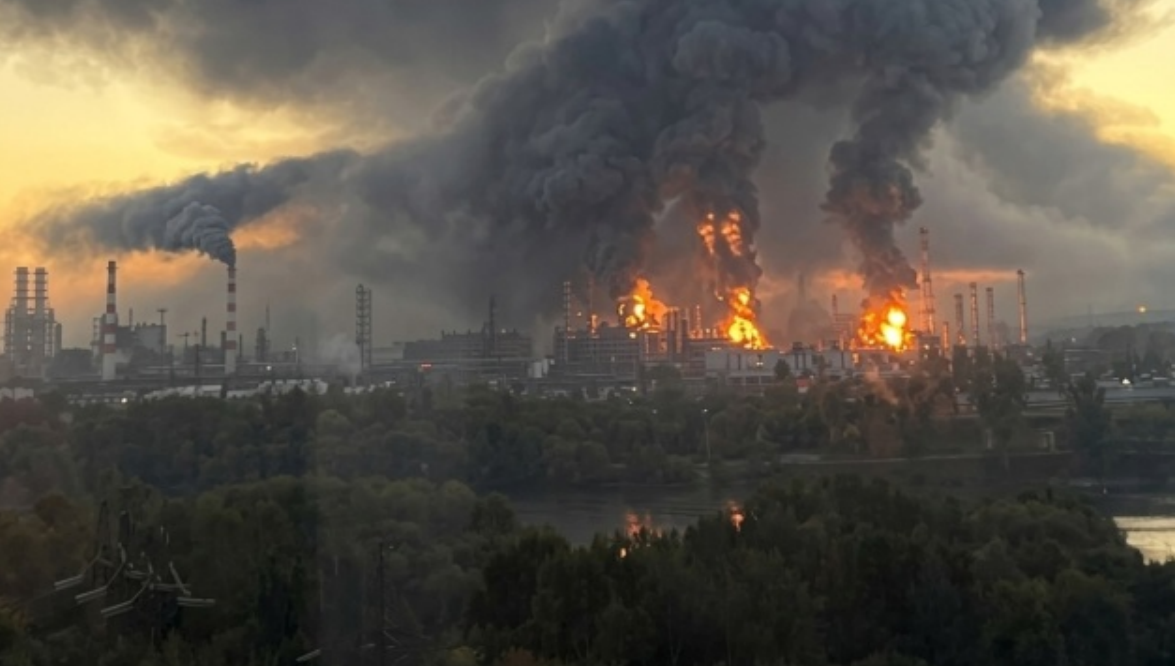
The Moscow Oil Refinery came under attack at a moment when Russia’s fuel market is already operating with increasingly limited room for maneuver. Overnight on September 20, drones reached the territory of the facility. Russian authorities confirmed damage to one of the refinery’s facilities, while Reuters witnesses reported seeing columns of smoke above the refinery. The exact scale of the damage has not yet been disclosed.
But the significance of the attack goes beyond the refinery itself.
In 2024, the Moscow Oil Refinery processed 11.6 million tonnes of crude oil. Its output included around 2.9 million tonnes of gasoline and 3.2 million tonnes of diesel fuel. The plant is a major part of the fuel supply system serving Moscow and the surrounding region.
That is why even a partial disruption at a facility of this scale creates a problem that cannot be solved with a single administrative decision.
Russia now has to either restore its own refining capacity as quickly as possible or compensate for the lost volumes through other refineries. But with the domestic fuel market already under pressure, every additional loss of refining capacity leaves less room for maneuver.
The consequences are already being felt across the domestic market. Reuters has reported shortages of some petroleum products, rising fuel prices and long lines at gas stations in different Russian regions.
For the authorities, this means continued intervention in the market: restricting exports, reallocating available supplies and trying to prevent the shortage from becoming even more severe.
But an administrative decision cannot replace damaged equipment.
That is why the strike on the Moscow refinery matters far beyond the facility itself. It hits a critical link in the chain connecting crude oil production to gasoline and diesel at the pump.
If the damage proves significant or operations remain restricted for an extended period, pressure on Russia’s domestic fuel market will increase.
The problem for the Russian system is that the consequences do not end at the refinery gates.
If the plant loses part of its capacity, fuel has to be found elsewhere. That means additional transportation, new restrictions and even greater pressure on the refineries that remain operational.
And that raises the central question: how much more pressure can the system absorb?
The Moscow Oil Refinery is not simply another industrial facility. It is part of a fuel chain that supports transportation, industry and one of Russia’s largest metropolitan regions.
Now that chain has taken another hit.
The equipment has to be assessed. The damage has to be repaired. Lost volumes have to be replaced. And the fuel still has to reach the drivers and businesses that depend on it.
The longer that process takes, the more expensive every new disruption becomes.
For Russia, this is no longer simply a question of one refinery. It is a question of how long its fuel system can continue operating under sustained pressure.
The Moscow refinery is now another warning sign for the entire system.
And if attacks on refining infrastructure continue, the numbers will no longer be measured only in damaged facilities.
They will be measured in millions of tonnes of fuel that the system can no longer produce.



Leave a comment